Short version
Mostly, yes. Both are a fabric shell filled with down, fiber or cotton and stitched to keep the fill in place. The difference is the job each is built for. A duvet insert usually has a plain shell and corner loops so it can tie inside a cover. A comforter is usually finished on its face and used on its own, often sold with matching shams. Many products are sold as both, so you should check the listing for loops, shell fabric and size rather than trusting the name.
This guide is for: anyone looking at a listing, or at a bed layer you already own, and trying to work out whether it belongs inside a cover or on top of the bed.
Key Takeaways
Three figures carry the whole answer: how sellers name these products, how many add loops, and how widely queen sizes spread.
- 4 of the 9 seller pages we read sold one product under both names, so the name alone does not tell you what you are buying.
- All 9 pages stated corner loops or tabs, including the 2 that call the product only a comforter, so loops do not settle it either.
- Queen sizes on the listings we read ran 88 to 98 inches wide, so you measure in inches, not size names.
What is a duvet insert?
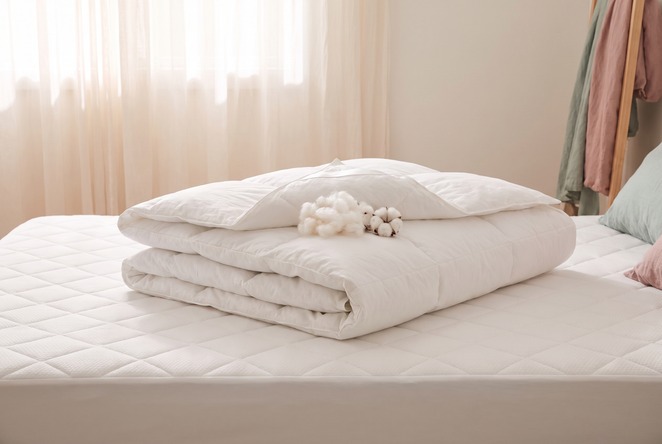
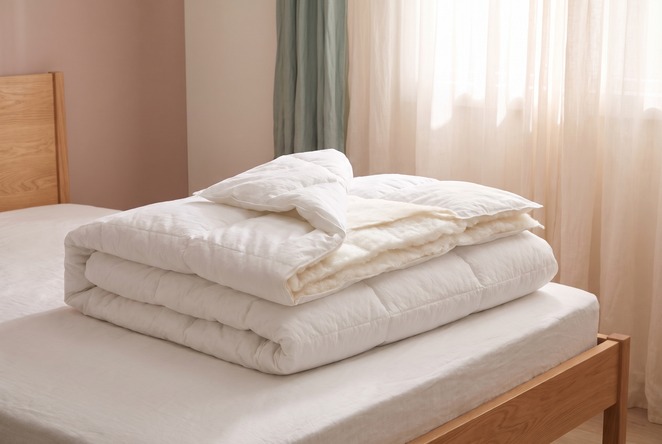
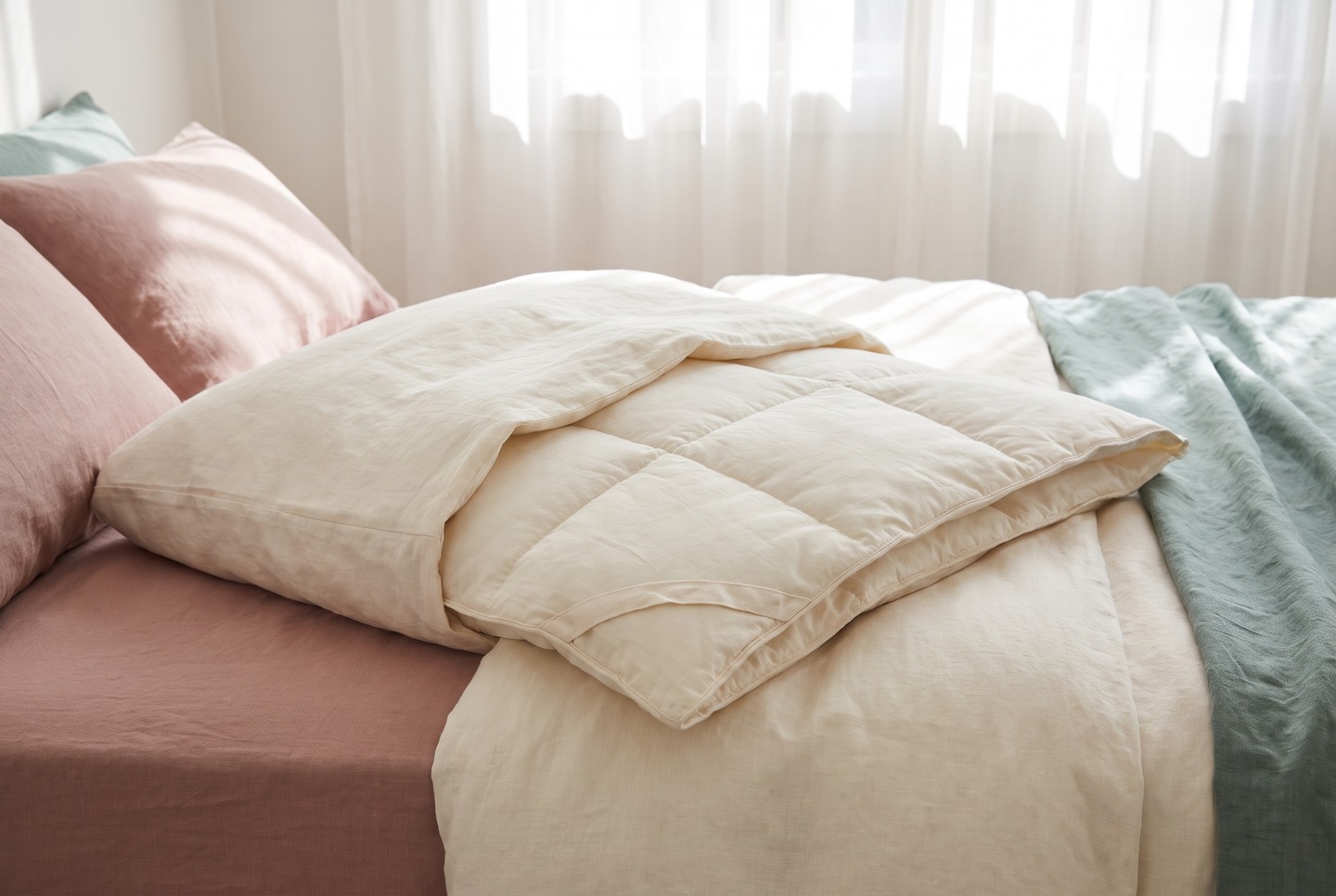
A duvet insert is a filled, stitched bed layer made to go inside a removable cover, the way a pillow goes inside a pillowcase.
The Company Store, a bedding seller, describes it as an insulating top layer of down or down alternative. Stitched chambers join the top and bottom of the shell so the fill stays even (The Company Store). It is built to be covered. Nearly every design choice you will see follows from that one fact.
You never see the shell once the bed is made. So makers keep it plain. They put their effort into a tight weave, often cotton. The corners give it away. Inserts typically use buttons, ties, loops or snaps at all four corners so you can fasten them to a cover (Sleep Foundation).
Fill and weight vary as widely as they do on any comforter. Boll & Branch sells its down insert in three weights, each inside a 100% organic cotton shell (Boll & Branch). Birch lists 40 oz of a down and wool mix in its full/queen insert and 50 oz in its king (Birch).
The bare word "duvet" muddies things. In Britain it means what Americans call the insert (Rest). American guides often use it for the insert and cover as a pair (Tom's Guide). On a US listing, you have to read past the title to learn which one ships. If you want the fill options for a cotton insert, the guide to what is inside a cotton duvet insert covers them.
What is a comforter?
A comforter is a filled, stitched bed layer finished to be used on its own as the top of the bed, with no separate cover required.
In a comforter, the fill and the outer fabric are sewn as one unit, so no part comes off (Parachute). The fabric you sleep under is the fabric everyone sees. Makers treat it as decoration.
You can see this in how comforters are sold. A Utopia Bedding queen set is a printed comforter of 88 by 88 inches. It comes packed with two standard shams at 20 by 26 inches (Amazon listing). Ashley's farmhouse full/queen set pairs a 90 by 94 inch comforter with two shams. Its face and reverse are 200 thread count cotton percale (Ashley). A Martha Stewart queen set is reversible, with a cotton face and reverse around polyester fill (Amazon listing).
The pattern holds across these listings. A comforter is sold as a finished look, often with matching shams, while an insert is sold as a part you dress. That choice costs something at laundry time. With no cover, you wash the whole piece each time. Matteo, a bedding maker, notes that a comforter's bulk means many need professional laundering or an extra-large washer (Matteo).
Federal labeling rules see the same two parts. 16 CFR Part 303 lists comforters among the beddings it covers. One of its sample origin labels reads "Comforter Filled, Sewn and Finished in the U.S. With Shell Made in China" (16 CFR 303.33). Even the law splits a comforter into a shell and what goes inside, just as you would with an insert.
How is a duvet insert built differently from a comforter?
The fill and stitching can be identical. The two differ in shell finish, corner fasteners, and how the piece is sized and sold.
Take away the cover and the two can be identical inside. The Company Store says they are almost the same thing at a glance, split by features and intended use (The Company Store). The table sets out where typical builds part ways, with our own judgement of how far you can trust each sign.
| Feature | Typical duvet insert | Typical comforter | How far to trust it (our judgement) |
|---|---|---|---|
| Shell fabric | Plain, one fabric, often cotton | Printed or dyed face, sometimes a different reverse | Fairly reliable |
| Corner loops or tabs | 4 to 8, for tying into a cover | Often none, but many now have them | Weak on its own |
| Sold with | Nothing; cover bought separately | Matching shams in a set | Reliable |
| Fill and stitching | Down, fiber or cotton; box or channel stitching | Same range | Not a sign |
| Size | Matched to a cover | Cut to whatever width the maker likes | Weak; sizes overlap |
| Washing | Rarely, since the cover takes the wear | The whole piece, more often | Follows from use |
That last column is ours, drawn from the pages counted below. You won't find it from a maker. The fill row matters most. Stitching is not what separates them: box, channel and sewn-through patterns turn up on both, as the guide to baffle box, sewn-through and channel construction explains. When you are trying to tell which one you own, look at the shell and the corners first.
Why do duvet inserts have corner loops?
Loops tie the insert to ties inside the cover so it stays spread out. They show a piece can be covered, though many comforters carry them too.
A cover is a loose fabric bag. Without anchors, the insert slides to one end. Most covers you buy have ties inside to stop that. One Wayfair cover listing states that four inside corner ties keep the insert from shifting or bunching (Wayfair). The insert's loops finish the job.
Some makers add more than four. Bare Home's insert lists 8 loops for tying into a cover (Bare Home). Brooklinen sells a down comforter, not an insert, yet Sleep Foundation notes it has corner loops to hold it in place inside a cover (Sleep Foundation).
So loops make a weak test. NapLab's guide says a comforter will not have corner tabs sewn in the way an insert does (NapLab). The listings counted for this guide do not bear that out, because both products named only as comforters stated loops. You can take loops as proof a piece is ready for a cover, but not as proof it was never sold as a comforter. If your insert drifts even with every tie fastened, why cotton duvets shift covers the causes.
What do sellers call these products on their own pages?
We counted names on 9 seller product pages. Each used the insert name, the comforter name or both, and every one listed loops or tabs.
We read 9 seller product pages on November 4, 2026, each for a filled bed layer sold in US sizes. We recorded only what each page states: its product name, whether it lists corner loops or tabs, and whether it says the piece works without a cover. This is a count of page wording. We handled and tested no products.
- Called only a duvet insert: 3 pages, all from bedding makers' own sites
- Called only a comforter: 2 pages, both Walmart listings
- Called both names: 4 pages, across maker sites, Walmart and Amazon
| Product page | Name used | Loops or tabs stated | Says it works uncovered |
|---|---|---|---|
| Bare Home | Insert | Yes, 8 | Yes |
| Birch | Insert | Yes | Not stated |
| Boll & Branch | Insert | Yes, 4 | Not stated |
| Cannon Heritage | Comforter | Yes, 4 | Yes |
| Twin Ducks Pescara | Comforter | Yes | Not stated |
| Linens & Hutch | Both | Yes, 4 | Not stated |
| Down for Good | Both | Yes | Not stated |
| Peace Nest | Both | Yes, 8 tabs | Not stated |
| Delara | Both | Yes, 8 tabs | Not stated |
All 9 stated loops or tabs. Just 2 said plainly that the piece works uncovered. Sorting by name alone gives you a mixed pile. This is a small, hand-picked set. You should read it as how listings word things, not as market share.
Are duvet inserts and comforters sized differently?
Queen sizes overlap. Inserts and comforters we read ran from 88 by 88 to 98 by 98 inches, so measure rather than trusting the size name.
Size names do not separate the two. The table lists the full/queen or queen dimensions printed on each listing this guide read.
| Listing | Sold as | Width by length |
|---|---|---|
| Birch | Duvet insert | 88 by 92 in |
| Utopia Bedding set | Comforter | 88 by 88 in |
| Ashley farmhouse set | Comforter | 90 by 94 in |
| Martha Stewart set | Comforter | 92 by 96 in |
| Reversible full/queen set | Comforter | 98 by 98 in |
The insert in the table, Birch's, sits at the small end, and the largest comforter is 10 inches wider. With no cover to fill, a comforter can be cut as wide as its maker likes. You size an insert to its cover.
Saatva advises a cover the same size as the insert or a couple of inches smaller (Saatva). Bare Home suggests a match or an insert 1 to 3 inches larger on each visible side. It also says to ignore the size name until the two measurements agree (Bare Home). Both sellers want the insert to reach the cover's seams. So measure both pieces before you buy.
Can you use a duvet insert without a cover?
Yes. The insert works fine bare, but the plain shell then takes all the wear and every wash, which a cover would otherwise take for it.
NapLab says that if the tabs do not bother you and you like the plain look, an insert can serve as a comforter (NapLab). A Forbes reviewer found the Avocado down insert soft enough to use without a cover, though it was designed for one (Forbes).
The catch is care. A cover is the layer you wash, and the insert behind it stays cleaner. Parachute, a bedding seller, says the cover gets washed often and the insert only occasionally (Parachute). Down for Good, which sells cover panels for its insert, recommends washing the insert twice a year (Down for Good). Uncovered, the insert takes sweat and spills directly, so you will wash it as often as a comforter. Each of those washes is a long, bulky load.
You may care about looks too. You see the loops. The shell was picked for its weave rather than its face. If you want a bare bed most nights, look for a listing that says the piece works with or without a cover, as 2 of the 9 counted here did. That wording tells you the maker planned for both uses.
Can you put a comforter inside a duvet cover?
Yes, if the sizes match. A cover protects a comforter and changes its look, and loops on the comforter help it stay put inside.
Sellers' own guides say so. Modern Dane, a bedding seller, says a comforter can serve as an insert if its size is reasonably close to the cover's (Modern Dane). Rest adds that a cover protects a comforter from wear and can extend its life (Rest).
Fit is the limit. Bedsure warns about a filled piece that is larger than its cover. It compresses at the closure end and leaves cold spots at the far corners (Bedsure). A 98 by 98 inch comforter will not sit cleanly in a cover cut for a 90 inch insert. You should check for loops as well. Without them, a comforter can slide inside the cover like any loose insert.
You can expect a little more warmth. A cover is a layer of fabric in its own right. A 2022 study tested 64 bedding systems on a thermal manikin. It estimated the insulation a quilt cover adds as its own increment (Building Simulation, 2022). So you sleep warmer under a covered comforter than a bare one. You may feel it in summer.
Common questions
Six shorter answers on names, warmth, loops, plain shells, cover fit and what the label on a comforter or duvet insert must show.
Is a duvet the same as a duvet insert?
In British use, yes, since "duvet" names the filled layer itself (Rest). In American shops the word often means the insert and cover together (Tom's Guide), so you should check what a listing ships.
Is a duvet insert warmer than a comforter?
Not by type. Warmth comes from the fill and how much of it there is. A 2022 thermal manikin study tied a quilt's weight per unit area to the room temperature that feels neutral under it (Building Simulation, 2022). You can compare ounces across both kinds, such as Avocado's 20 to 24 oz and 24 to 28 oz inserts (Sleep Foundation).
Do comforters ever have corner loops?
Often. Both comforter-only listings in the count above stated loops, and Sleep Foundation notes Brooklinen's down comforter has them too (Sleep Foundation).
Why is a duvet insert shell usually plain?
A cover hides it. So the money goes into the weave, and Boll & Branch, for example, describes a tightly woven, down-proof organic cotton shell built to keep the fill inside (Boll & Branch).
Does an insert have to match its cover exactly?
No. Saatva suggests a cover the same size as the insert or about 2 inches smaller (Saatva), so you measure both in inches.
What must the label on a comforter or insert show?
The federal textile rules define bedding to include comforters (16 CFR Part 303). The FTC's textile rules require labels to show the generic fiber names and percentages by weight, the maker or marketer, and the country where the product was processed or made (FTC). The rules also show filling disclosed on its own label line, written as "Filling: 100% Cotton" (16 CFR Part 303).
Sources
Reading list for this cotton duvet piece, each title paired with the section where it does its work.
- The Company Store (thecompanystore.com), at work in “What is a duvet insert?”; “How is a duvet insert built differently from a comforter?”.
- Sleep Foundation (sleepfoundation.org), at work in “What is a duvet insert?”; “Common questions”.
- Boll & Branch (bollandbranch.com), at work in “What is a duvet insert?”; “What do sellers call these products on their own pages?”; “Common questions”.
- Birch (birchliving.com), at work in “What is a duvet insert?”; “What do sellers call these products on their own pages?”; “Are duvet inserts and comforters sized differently?”.
- Rest (rest.com), at work in “What is a duvet insert?”; “Can you put a comforter inside a duvet cover?”; “Common questions”.
- Tom's Guide (tomsguide.com), at work in “What is a duvet insert?”; “Common questions”.
- Parachute (parachutehome.com), at work in “What is a comforter?”; “Can you use a duvet insert without a cover?”.
- Amazon listing (amazon.com), at work in “What is a comforter?”; “Are duvet inserts and comforters sized differently?”.
- Ashley (ashleyfurniture.com), at work in “What is a comforter?”; “Are duvet inserts and comforters sized differently?”.
- Amazon listing (amazon.com), at work in “What is a comforter?”; “Are duvet inserts and comforters sized differently?”.
- Matteo (matteola.com), at work in “What is a comforter?”.
- 16 CFR Part 303 (ecfr.gov), at work in “What is a comforter?”; “Common questions”.
- 16 CFR 303.33 (ecfr.gov), at work in “What is a comforter?”.
- Wayfair (wayfair.com), at work in “Why do duvet inserts have corner loops?”.
- Bare Home (barehome.com), at work in “Why do duvet inserts have corner loops?”; “What do sellers call these products on their own pages?”.
- Sleep Foundation (sleepfoundation.org), at work in “Why do duvet inserts have corner loops?”; “Common questions”.
- NapLab (naplab.com), at work in “Why do duvet inserts have corner loops?”; “Can you use a duvet insert without a cover?”.
- Cannon Heritage (walmart.com), at work in “What do sellers call these products on their own pages?”.
- Twin Ducks Pescara (walmart.com), at work in “What do sellers call these products on their own pages?”.
- Linens & Hutch (linensandhutch.com), at work in “What do sellers call these products on their own pages?”.
- Down for Good (downforgood.co), at work in “What do sellers call these products on their own pages?”; “Can you use a duvet insert without a cover?”.
- Peace Nest (walmart.com), at work in “What do sellers call these products on their own pages?”.
- Delara (amazon.com), at work in “What do sellers call these products on their own pages?”.
- Reversible full/queen set (amazon.com), at work in “Are duvet inserts and comforters sized differently?”.
- Saatva (blog.saatva.com), at work in “Are duvet inserts and comforters sized differently?”; “Common questions”.
- Bare Home (barehome.com), at work in “Are duvet inserts and comforters sized differently?”.
- Forbes (forbes.com), at work in “Can you use a duvet insert without a cover?”.
- Modern Dane (moderndane.com), at work in “Can you put a comforter inside a duvet cover?”.
- Bedsure (bedsurehome.com), at work in “Can you put a comforter inside a duvet cover?”.
- Building Simulation, 2022 (link.springer.com), at work in “Can you put a comforter inside a duvet cover?”; “Common questions”.
- FTC (search.ftc.gov), at work in “Common questions”.
- 16 CFR Part 303 (govinfo.gov), at work in “Common questions”.